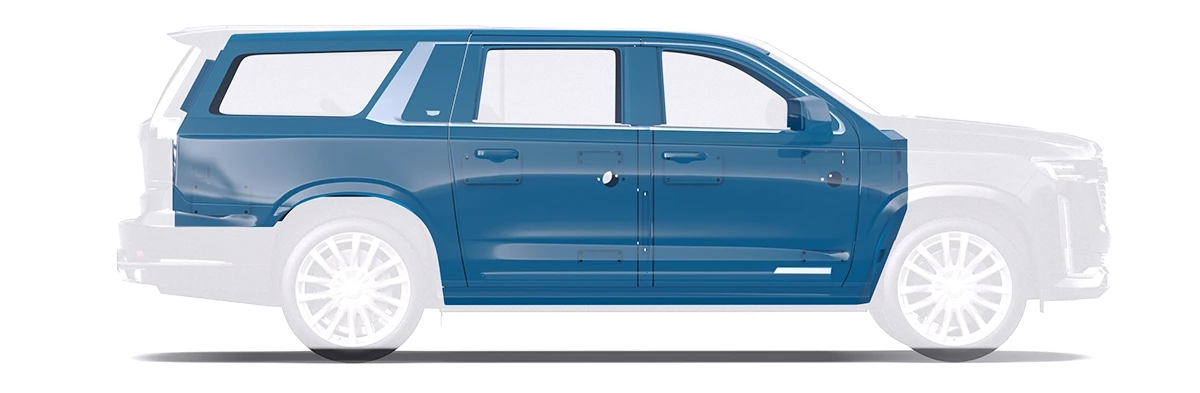
In short: "armored vehicle" covers two different things. A military armored vehicle is designed with armor from the start, like an armored personnel carrier. An armored civilian vehicle is a regular SUV or van that receives its protection after production. Hebrew even has two words for them, and the difference explains a lot about what the vehicle can do.
Two kinds of armored vehicle
Hebrew Wikipedia defines an armored fighting vehicle as a vehicle with protection and armor used for combat or combat support. Civilian vehicles that were not manufactured with armor and had it added later, such as buses, executive cars and off-road vehicles, go by a different Hebrew term, "rechev memugan", a protected vehicle.
The difference is the starting point:
| Military armored vehicle | Armored civilian vehicle | |
|---|---|---|
| Starting point | Designed with armor | A civilian vehicle, protected afterwards |
| Purpose | Combat or combat support | Protected travel for people and equipment |
| Appearance | Military and conspicuous | Like the original vehicle |
| Examples | APC, tank | SUV, Sprinter, work truck |
What people mean when they search
When someone searches for armored cars in Israel, they almost always mean the civilian kind: a car that looks ordinary and is protected on the inside. Israeli newspapers use the same loose wording, calling armored civilian cars by the military word.
What is an executive car?
An executive car is a luxury vehicle used by senior figures. It does not have to be armored, but Wikipedia lists executive cars among the vehicles that receive protection later on. In an armored executive car, the goal is to combine the comfort of a luxury vehicle with the protection of an armored one.
In our fleet, those are the Cadillac Escalade ESV and Chevrolet Suburban, which we compare in a full side-by-side.
What is inside an armored civilian vehicle
An armored vehicle is protected from the inside, so from the outside it looks almost like the car it started as. In our vehicles, the protection includes:
- Ballistic glass
- 360° perimeter protection, including roof, floor and firewall
- An overlap system that closes the gaps between armored parts
- Battery, ECM and fuel tank protection
- Reinforced suspension and run-flat tire inserts
We cover the full process in how armored vehicles are built.
Why the difference matters
It affects three things:
- Discretion. An armored civilian vehicle looks like a regular car, and that is part of the point. A military vehicle draws attention.
- Comfort. The original passenger seats, climate control and equipment stay in place.
- The law. In Israel, armoring a civilian vehicle is subject to clear rules, as we explain in can a private citizen own an armored car in Israel.
Frequently asked questions
Is every armored car a military vehicle? No. Most armored cars people encounter are civilian vehicles that were protected after production.
Can you spot an armored car from the outside? Usually not easily, because the armor sits under the trim.
What should I look for if I need protected travel in Israel? An armored car with a driver. That is the service we provide: travel in an armored vehicle, subject to prior approval by the Israel Police.
Sources
- Armored fighting vehicle, Hebrew Wikipedia: definitions of the two terms
- Armored car (VIP), Wikipedia: civilian armored vehicles