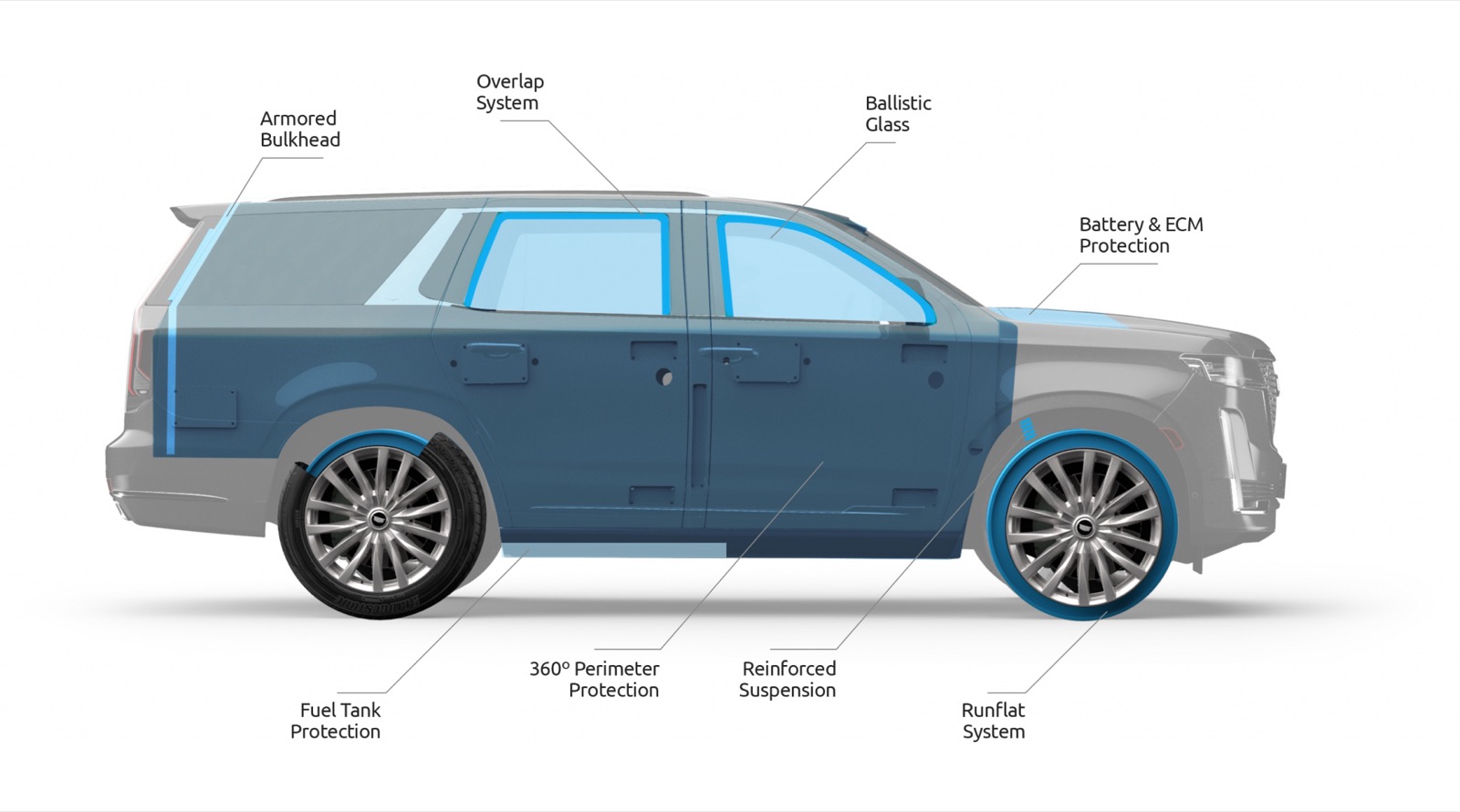
From the outside, a well-armored SUV looks almost exactly like the one it started as. The work is hidden behind the trim: armor inside the doors, pillars, roof and floor, glass several centimetres thick, and a chassis upgraded to carry it all. This article follows the process step by step.
1. Engineering before the first cut
Armoring is planned before the car is taken apart. Armor adds a great deal of weight: around 1,500 lb (about 680 kg) on a typical passenger vehicle, and considerably more on military-type trucks. The finished vehicle has to stay within the manufacturer's gross vehicle weight rating.
So engineers calculate the centre of gravity before and after armoring, taking into account the vehicle's weight and the stiffness of its springs, and run a stress analysis of the structure. These numbers decide how much armor the vehicle can carry and what has to be upgraded to carry it.
The choice of base vehicle matters too. Steel armor cannot be welded to aluminium, and aluminium tends to buckle under the weight of steel, so aluminium-bodied vehicles need a different approach. Full-size SUVs such as the Chevrolet Suburban and Cadillac Escalade are among the vehicles most often armored.
2. Down to the shell
The vehicle is stripped down to its bare steel or aluminium body: seats, carpets, headliner, door trims and the original glass all come out. The armor is fitted to the inside of the body, so when the vehicle is reassembled its exterior is unchanged.
3. Opaque armor: steel and composites
The opaque areas (doors, pillars, roof, floor, the firewall between the engine and the cabin, and the rear of the cabin) are lined with ballistic materials.
- Ballistic steel is the most widely used material. It is hardened steel made specifically to stop bullets, and it can be cut and formed to follow the body's shape.
- Composites such as Dyneema, an ultra-high-molecular-weight polyethylene, weigh about a quarter as much as ballistic steel. They are thicker, which makes it harder to refit the original upholstery.
- Aramid fibres such as Kevlar are used where weight matters most.
Many vehicles combine materials, using each where it suits the shape and weight of the area best.
4. Ballistic glass
The original windows are replaced with ballistic glass: several layers of glass bonded with plastic interlayers, with a polycarbonate layer on the inside.
It works in two stages. The hard glass layers flatten the bullet and spread its energy. The softer plastic layers then deform and absorb what is left. The polycarbonate on the inner face also stops spall, the fragments of glass that would otherwise fly into the cabin from the inside surface.
Ballistic glass is typically several centimetres thick, much thicker and heavier than ordinary car glass. Flat glass is the simpler option. Curved glass that keeps the vehicle's original look is more demanding to produce and install, but it is what keeps an armored vehicle discreet.
5. Closing the gaps: the overlap system
Armored panels and armored glass are only as good as the joins between them. Door gaps, the edges of the glass and the places where two panels meet are exactly where a bullet meets the least resistance.
An overlap system closes those paths: armor pieces are arranged so that they overlap at the joins, leaving no straight line through a gap into the cabin.
6. Protecting what keeps the car moving
A vehicle that cannot drive away has lost most of its protection. Beyond the cabin, the armoring covers critical components:
- Battery and ECM (engine control module): if either is disabled, the vehicle stops.
- Fuel tank: protected against penetration.
- Run-flats: an insert inside each tyre carries the vehicle when the tyre is punctured or deflated. Tyres are the most obvious target for immobilizing a vehicle, and run-flat inserts are designed to let it keep driving to safety even with one or all tyres flat.
7. A chassis that can carry it
Armored vehicles can be 20 to 40 percent heavier than the vehicle they started as, and every part of the chassis feels it.
- Suspension is reinforced to carry the extra weight and keep handling predictable.
- Brakes are upgraded, because more mass takes longer to stop.
- Door hinges are reinforced, since armored doors are far heavier than standard ones.
- Door travel retainers limit how far a heavy door swings open.
Even with these upgrades, the extra mass is felt in braking and cornering, which is one reason armored vehicles call for trained drivers.
How our vehicles are built
The armoring in the 911VIP fleet provides 360° protection that includes the roof, the floor and the firewall, built to strict European standards. It includes:
- Multi-layer ballistic glass
- Battery and ECM armoring
- Fuel tank protection
- An overlap system
- Run-flat wheels
- Reinforced suspension and hinges, and door travel retainers
All ballistic materials are tested and approved by specialized ballistic testing laboratories.
Sources
- The Drive: Inside the armoring process of armored vehicles: engineering calculations, stripping, materials, weight, glass and build time
- Ballistic glass, Wikipedia: layered construction, polycarbonate spall layer and thickness
- Hutchinson VFI/MVFI run-flat system brochure: purpose of run-flat inserts
- Armored car (VIP), Wikipedia: materials and conversion process